ManMachine
@max@manmachine.me
Professional computer toucher.
Amateur photographer and musician.
Autistic.
Amateur photographer and musician.
Autistic.
ManMachine
@max@manmachine.me
fedi. one job.
most awoo replies to a single toot. go.
awoo
There is a technology which is so expensive to operate that *just by existing*, it has made things like RAM and hard drives unaffordable to me and the humans I know, because the expensive technology's operational demands are so high they had to buy RAM and hard drives *until there weren't anymore RAM or hard drives*.
*A technology with this property is not, and was never going to be, a "democratizing" technology*.
"Democratizing" seems to imply it brings some sort of power to everyone, more or less equally, "democratically". Is there a word for a technology which brings power exclusively to people who can afford high financial demands, and brings more power to you the more you are able to pay for it? Yes, there's a word for that. The word is "classist"
@mcc them: “democratizing”
me: [puts on the “they live” glasses]
them: “monopolizing”
"Nothing about LLMs is intelligent. There is no intelligence there. Artificiality isn't even applicable because you're lacking the intelligence.
We've been able to create artificial DNA and even artificial cells. Neither is robust, and both only survive for brief periods in controlled conditions, but they are real.
Artificial isn't really an antonym for real. It's an antonym for natural."
(Said by: @jezebelkat )
bluesky added a little 1/x marker at the end of posts to show number of posts in a thread and frankly fedi needs to copy that right the fuck now
edit: before you reply with "just use a server with a character limit you're happy with anything else is twitter bullshit" please consider that there may be other reasons why one might wish to append a reply to a post one wrote earlier
@eniko The fediverse doesn't need such "thread" abomination.
Just use a server with a high enough character limit and make it a single post.....
Everything else is old twitter bullshit we don't need here.
seriously one of the most annoying things about fedi is this stupid ass superiority complex that makes *some* people here go "oh we don't need that very useful and convenient feature, because that's for other *lesser* social media places"
I think the annoying thing about fedi is the double edged sword that having no algorithmic feed means those comments are given the same level of prominence as comments that aren't shit.
@eniko I agree, one of the issues often for open source I see is they build software, even ones made for many people, as if it is only for themselves. Where as in my open projects I came in with the perception of “what if others don’t want it exactly my way?”
Ironic when open source is about community
There's nothing to feel superior about. I think part of Bluesky's quick uptake, is that they had their house in better order right from the start.
I'd love fediverse to make something of a paradigm shift away from app-centric fedi with its clunky UX, where we focus on delivering solutions. Introduced as services to a more unified social networking space to participants on the network, and better tailored to their needs.
The 1/x marker would be a line of business logic in the specification of a Microblogging solution then, to be adopted by devs in their app or service implementation.
Wrote a blog post about it recently. Biggest challenge holding us back is social in nature.
muting this because jesus fucking christ
@eniko Oh no, what happened?
*looks inside*
Ah, once again Eni said something that should be common sense but is somehow considered controversial by a bunch of creepy weirdos
@eniko reminds me of this thing I saw yesterday where people said to just delete your discord account to show em
I get the sentiment but like, then I can't chat with friends anymore, and they're not about to move to one of the few options with tons of missing features.
Relatedly, I would love a "break up this long post" button that automatically breaks it up at the nearest paragraph breaks and applies the "1/x" marker and copies any hashtags at the end of the post to be at the end of each one in the thread.
Would need a slightly more complex UI change to give the ability to edit before posting but would be nice to have.
@eniko I would love for threads' posts to be more obviously connected, currently it's really confusing.
It's as confusing as on the website engineered to have as many misunderstandings, context-free outrage and discord as possible.
I for one hate super long posts, but maybe I’m weird.
I self annotate my threads with 1/ 🧵 and 🧵 / end etc but it is kinda a drag.
Does it? You can just put the whole thread in a single post, eliminating the need for threads in the first place. Unless your instance still limits to 500 characters, that is…
@eniko listen here, there's a specific level of convenience that's acceptable and it's exactly whatever I'm personally used to at the moment. Anything less is laughably primitive, anything more is for lazy people, which is bad.
@eniko Couldn't we also have that x be replaced by the actual depth of the thread? Perhaps too much CPU/storage when the world is selling off all excess computation to Big Techbro?
@eniko Yes! I’ve long thought something like this would be an improvement.
It could help keep threads in the right order or allow clients or servers to reconstruct a thread with missing parts after a federation hiccup.
Clients could opt to show all responses underneath the thread instead of breaking up a thread with a response to post 3/7.
It could help the creation of a decent UI that allows insertion or reordering during the drafting phase.
1/2
@eniko For this to make sense I think Mastodon would need the concept of multipart post.
YMMV, but I would prefer having proper threading (i.e. a tree) in more clients, and some degree of awareness of multipart posts or of a post group (could be used for these counts, and also to present these parts differently in the thread tree).
(I have no idea if this already exists, maybe there is some other system in the fediverse that actually does all that, I should investigate at some point, as I'm curious...)
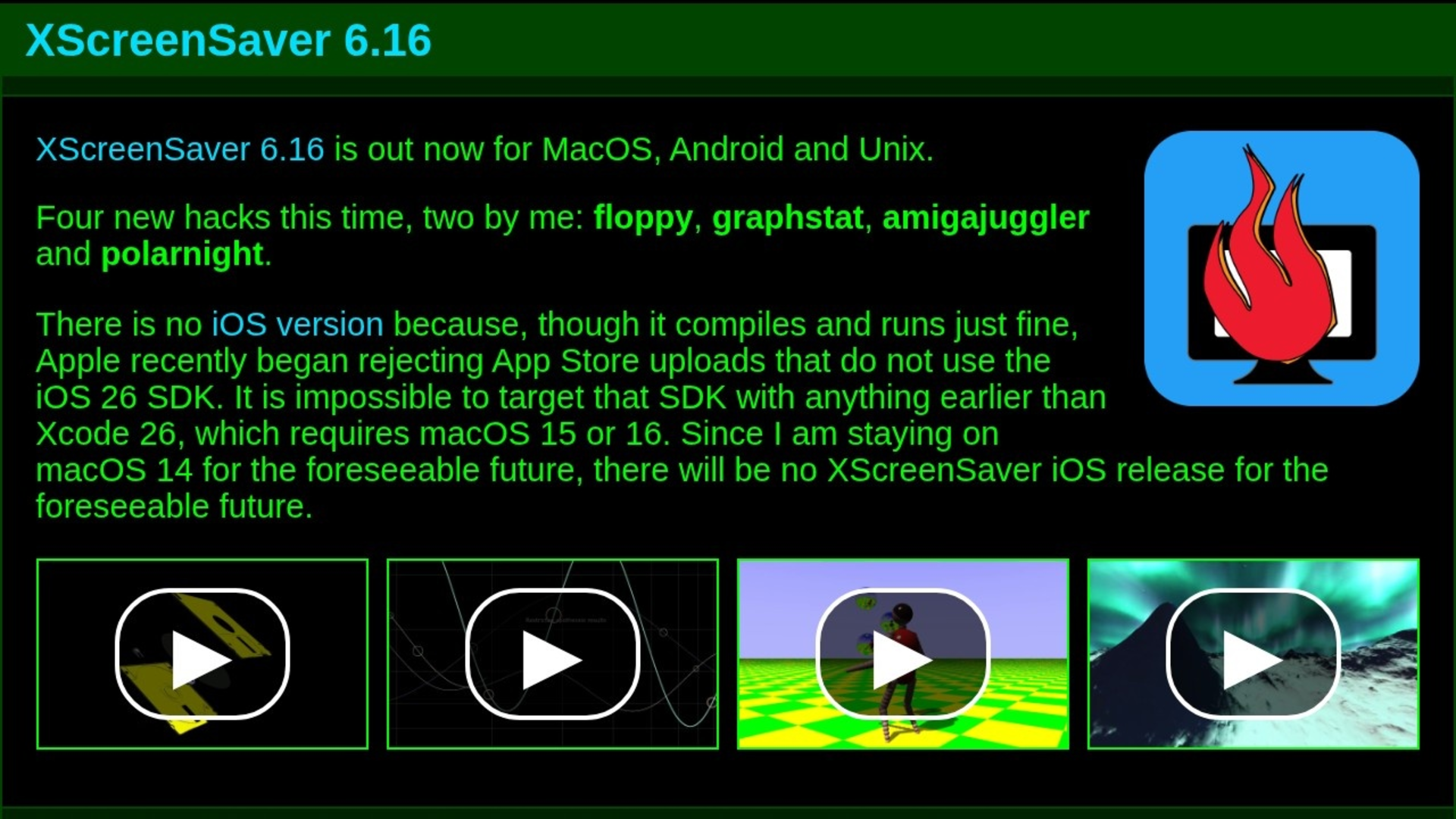
XScreenSaver 6.16 out now.
Four new hacks this time, two by me: floppy, graphstat, amigajuggler and polarnight.
There is no iOS version because Apple recently began rejecting App Store uploads that do not use the iOS 26 SDK. It is impossible to target that SDK with anything earlier than Xcode 26, which requires macOS 15 or 16. Since I am staying on macOS 14 for the foreseeable future, there will be no XScreenSaver iOS release for the foreseeable future.
https://jwz.org/b/yk_c
Alt...
Screenshot
@jwz today I learned your the person behind my favorite screensavers and it brought me joy
@jwz Would thoughts about running newer macOS in a VM on macOS 14 be welcome, or should I simply notice that the original post did not contain a question?
Also, I love the floppy, but it needs a sticker with an illegible hand-written label.
Dear Lazyweb,
1) Can someone please look at xscreensaver/configure.ac and explain to me what I need to do to get past "AM_GNU_GETTEXT not found in library" on e.g. Debian 13.5.
2) Can someone please rewrite xscreensaver/po/Makefile.* to not be complete garbage, because it's 20 years old, pure evil, and I have never understood it.
@jwz Gonna be honest. at least 60% of why I'm excited about Rust is never having to touch "configure" or "CMake" again
@mcc Like Jeff Goldblum taught us in Jurassic Park: "Oh yeah, [ I wrote a new build system that isn't 'make' ], oohing and ahhing, that's how it always starts, but later there's the running and screaming."
Why do you think there are so many replacements for "make"? Because *none of them got it right*.
@jwz Ah! So the thing is the reasons all the new C build systems wind up being just as bad as the old C build systems are actually more or less localized to C! There are specific design and historical attributes C has that create problems. In some cases by switching to another language you can actually escape those problems.
Until your Rust code inevitably needs to link a library written in C. Then the running and screaming starts.
@mcc Every time I have used a build system that was "purpose built" for some particular language, I have wanted to go all Master Pei Mei on their ass. Just use 'make' you petulant children!
I'm looking at you, Gradle. Five-Point-Palm Exploding Heart for everyone involved!
@jwz @mcc oh my lord. I use gradle right now because kotlin is bloody impossible to use without it.
I particularly love that every, god, damn, time I want to do something which is ever so slightly beyond "build this library into a jar" you either have to go on a hubt for some custom made plugin, or call some magic and utterly undocumented incantation.
Just look what I had to do to make the generated executable know where it was launched from: https://codeberg.org/loke/array/src/branch/master/gui2/build.gradle#L78
Or this bloody thing. I don't even remember why it's there, but it's some magic that we needed to make the build not break: https://codeberg.org/loke/array/src/branch/master/clientweb2/webworker/build.gradle#L54
@happyborg @mcc I am not saying 'make' is good. It is not. It's terrible. I am saying that everything that has ever tried to replace it has been both worse and less capable and thus a failure.
I am forever telling people that the worst part about getting it right the first time is that nobody realizes how hard it was. And I'm afraid that 'make', awful as it is, is one of those.
You didn't want a shell-based production system, but you needed one, you're welcome.
@jwz @mcc For simple projects I've used a Makefile with rustc. It is fine. The thing cargo really solves is dependency management, which is almost impossible to bake into a Makefile. It is miles ahead of autotools. However I do wish it had a "vendor all of my dependencies into this workspace" mode, after which I could use some Makefile techniques.
@mcc
I tend to disagree on the fact that cargo is superior to make.
On one hand, make is pretty simple, but too powerfull for it's own good, so generated code (with autoconf or cmake or) could seems totally obfuscated.
One the other hand, cargo isn't as powerfull but be identically cryptic (to me at least) if you try to do some specific build (in my case a static binary with a SSL layer)
In addition, but that could be only on the projects i tried, I found that compiling rust is many many times more ressource intensive than c/c++ . And cargo also redo steps even when the source and dependencies didn't changed.
@jwz
@jwz this is getting close to _not_ lazy web 😂
> I do not publish a public source code repository. I publish releases as tar files (above) and welcome submissions and change requests via email. It's fine. You'll get over it.
@jwz so an `autoreconf -i --force` is telling me `configure.ac:1145: warning: macro 'AM_GNU_GETTEXT' not found in library`. But that is defined in `/usr/share/gettext/m4/gettext.m4` so it looks like an include issue or something. Still digging.
@jwz I haven't figured out _why_ yet.. But `autoreconf -I /usr/share/gettext/m4 --force` will work, you'll get a warning that is fixed by adding a `AM_GNU_GETTEXT_REQUIRE_VERSION`. I tested before and after `AM_GNU_GETTEXT` and it seemed to work anywhere.
I didn't see anything in the docs about how you're regenerating configure, so this might not actually help?
@grimmy If there was an emoji for me staring at you with cold, dead, non-understanding eyes, it would be here
`patch -p1 -i foo.patch` from the source root. You still FTBFS on Debian without telling autoconf about the include path, but since that wasn't the "assignment"
--- a/debian/rules 2025-12-04 14:41:56.676490182 -0600
+++ b/debian/rules 2026-09-05 14:16:59.639975007 -0500
@@ -4,7 +4,10 @@ DH_VERBOSE = 1
export DH_OPTIONS=-v
%:
- dh $@ --without autoreconf
+ dh $@
+
+override_dh_autoreconf:
+ autoreconf -I /usr/share/gettext/m4
override_dh_auto_configure:
./configure --prefix=/usr
@grimmy I rebuild the configure file with "aclocal; autoconf; autoheader". How was I supposed to determine the magic pathname "/usr/share/gettext/m4", which doesn't exist on my Debian 13.5 machine anyway?
@jwz oh crap, I'm on forky (well sid) so this may be a different issue. Gimmie a few to take a look at it on trixie.
@jwz regenerating configure with `aclocal && autoconf && autoheader` gets me a clean configure on deb 13.
Did the OS you created the release tarball on have a gettext version greater than 23 or so?
The "proper" fix for this with newer gettext is to run autopoint before aclocal. Problem is that wants to blow away your po/Makefile.in.in. I don't know if you have anything special in there.
This would copy the gettext macros into aclocal.m4 in the tarballs fixing the problem.
@grimmy WTF is autopoint??
The very existence of a .in.in file makes me die inside. Is there any sane reason I should be using that instead of just writing a rule that runs msgfmt manually?
@jwz autopoint is a new thing from gettext, They install their m4 scripts outside of $prefix/share/aclocal now which is causing the issue and autopoint fixes it.
If you don't have any customization to po/Makefile* id' just blow it away and let gettext to it. dshea has a comment about it https://www.jwz.org/blog/2026/09/xscreensaver-6-16/#comment-272004
This would mean that you also need to `autopoint; aclocal; autoconf; autoheader` to generate your configure script before releases. That'll make sure all the macros end up in aclocal.m4.
@grimmy FFS. Welp, MacPorts (on my dev machine) doesn't have "autopoint". It also inexplicably says the "gettext" port is version 1.0 which doesn't exist. It seems that "port activate gettext @0.22.5_0" rolls things back to an un-fucked state where AM_GNU_GETTEXT exists again. "Hooray".
@grimmy Oh hey, I just noticed that $CATALOGS is always blank in the triply-generated po/Makefile, so this has been an even bigger waste of god damned time than I thought. I don't know how many years it has been since "make install" installed any of the localizations. But nobody has complained about it, either.
@jwz YIKES!
@grimmy Yyyyyup... So I think I got po/ building and installing, finally, but now it seems that intltool-update is ignoring the strings in the .ui files even though POTFILES.in says e.g. "[type: gettext/glade] driver/prefs.ui".
This whole house of cards is certainly living up to my past experiences with it.
@jwz I haven't used the type syntax in awhile so I'm not sure. Pidgin 2 doesn't have ui files, but it does have xml.in files in POTFILES.
Pidgin 3 uses meson which handles gettext very differently but our POTFILES just has bare filenames for everything even ui files.
@grimmy Running "xgettext driver/demo.ui" *does* extract the strings into messages.po though, so I don't know what the hell is going on.
@jwz yeah it's weird, i see them in po/Makefile under potfiles, but then don't end up in the pot file even after `make -C po xscreensaver.pot`. Using the command from pidgin 2 doesn't seem to make a difference either.
@jwz
Amiga Juggler!
It's a bit hires 😀
https://alphapixeldev.com/eric-grahams-1987-amiga-juggler-raytracer-part-2-porting-to-sdl/
I use my work Mac mostly to display xscreensaver until someone at GNOME gets their #!@% head out of their #!@%
@jwz I have used https://www.darlinghq.org for crossclownpilation for the fruit company parodies on operating systems. And it works for me!™
There’s a certain … cassandra-esque irony in people getting frustrated with LLMs not “doing what they tell them”, and are now, undestanding-by-fire why domain-specific formal languages were developed in the first place.
If you want to skip straight to the part where the computer does (mostly) exactly what you tell it to do, might I recommend a programming language.
![[?]](https://sbom.tilde.website/accounts/avatars/000/018/914/original/7579ef0d7dee18b7.png) a very weeny construct 💀 [xe/xem/xyr https://en.pronouns.page/xe] » 🌐
a very weeny construct 💀 [xe/xem/xyr https://en.pronouns.page/xe] » 🌐
@pho4cexa@tiny.tilde.website
who up despairing about their employability in an industry they find abhorrently revolting
despite an early all-consuming passion for the machines and their fascinating puzzle-like abstractions
and contained within them the potential for good and connection and community-building
and a compulsion to increase your symbiosis with them
there are so many of us
we are not the industry
i bet we rival whole cities in population
there has got to be a way to concentrate our collective will
So here's a weird thing that keeps happening:
1. botlicker shows up to open source project and pushes some slop
2. overwhelmed / exhausted / fed up maintainer slightly mischaracterizes their usage[1].
3. botlicker absolutely EXPLODES in an unhinged rage, demanding an apology, often repeatedly in multiple forms even if one is already offered.
…
@glyph 1. Wannabe is trying to bluff their way past the bouncer without paying by projecting confidence and pretending to be important.
2. "Don't you know who I am?" "No I do not. GTFO."
3. Double down. There is no benefit to honesty once you have committed to the bit. Admitting "you got me, I'm nobody, my bad" does not advance the con, and precludes further cons.
Nothing new under the sun.
@jwz as ever, "plonk" is a complete sentence, but I am just baffled by the fact that this is happening repeatedly now. never seen anything like it before in literal decades.
@glyph It's a certainty that the "unhinged rage" was a 5 word prompt that they just expanded and pasted. They don't even care enough to use genuine anger.
@glyph When I swear at people, that is locally crafted, artisanal anger. They should treasure it.
i am constantly baffled by the lack of curiosity demonstrated by retro hardware enthusiasts who use llms to make their stuff. it's like... i thought we were here to understand how computers work from a historical and material perspective, in order to build a future for computation that empowers communities over corporate interests, and to redeem the knowledge bottled up in retro hardware design to enrich the commons. but no i guess you're here for the frisson of "lookie old thing does new thing"
Been playing around with the wonderful #colorboy palette by @skeddles and couldn't help making some #analognowhere stuff.
#colorboy #pixelart #unix_surrealism

Alt...
A pixel art dialog window of Puffy angrily asking "...YOU THINK I LIKE COMPUTERS?!"
Another one
#colorboy #pixelart #unix_surrealism

Alt...
A pixel art dialog window of Techno Mage daring someone to say "You need to download our app to continue" again.
@prahou @freddy That'd be cool. If it helps here's the font
https://opengameart.org/content/intrepid-monochrome-8-bit-font
the palette
https://lospec.com/palette-list/colorboy
and a bonus default Puffy

Alt...
Puffy looking mighty unimpressed
x86 assembly (16-bit) is so hard. there's so few registers and so many stupid rules about how you can use what register for which operation
@eniko I remember learning x86 assembly coming from the C64/6502 and first thinking "wow look at all those registers", then "wow look at all the weird rules about what you can use for what"... similarly "wow, 512KB of ram, luxury" then "oh segmentation is an adventure and a half"...
like. i didn't like C when i started to use it. but i warmed up to it and can see virtue in its simplicity. i can see why sometimes C is good, actually
i do not expect this will happen for x86 assembly
@eniko At least its (hopefully) not like SNES assembly where you have to change the A or X/Y registers from 8-bit to 16-bit mode and then back depending on the situation everywhere
@eniko that's one of the reasons why people were far more fond of the 68000 in spite of it also having its limitations (such as the split between address and data registers)
@eniko My favorite assembly is ARM, followed by 68000.
ARM had some really nice features. I enjoyed using it on the GBA. The engine I worked on mixed ARM assembly and C++.
I liked 6809, but it's been so long I can't remember if it is actually good or just better than 6502.
@eniko I feel like it gels most with people who get big dopamine hits from solving intricate little lateral thinking puzzles, sort of "I put a 16-bit value in ax, realise I will want the lower 8 bits later but also need to use al for interrupts, so I shift it left into ah and do what I need then shift it back when I need it and thus don't do any register copies or memory access" type stuff.
My experience is it has a way of making you alternate between feeling very clever, and then very dumb...
@Timberwolf yeah, I did feel a bit like that when removing any load/stores from the hot path. Freeing up one thing, then another, and another, until all the bits fall into place and suddenly the board is clear
But I feel like I would still enjoy this better if it was m68k or risc-v instead of x86 >_>
@eniko C and C++ *CAN BE* WONDERFUL languages if used "in simple ways" which THEY CAN. They become 'a mess' when 'badly used' or 'attempting to be too clever with them'. They can be a bit like "nuclear energy" can be used for good with proper setting/limits can become ultra destructive in the wrong hands. C is "a bit immune" to that but C++ on the contrary gives you "infinite rope to hang yourself with" 😐 Still it CAN be VERY useful when used correctly.
@gilesgoat @eniko I remember feeling that way about C++ 20 years ago, and now every time I hear about it adding a _new_ clever feature my only response is lol I think the fuck not.
@Farbs @gilesgoat being clever is never worth it. I always try to do things in the dumbest most straight forward way
@eniko @gilesgoat yep! My proudest tech directiony moment was on Card Hunter deciding that large amounts of code would be written and maintained identically in two languages rather than somehow bridge Java and AS3. It was so stupid. And it totally worked.
@eniko I learned x86 assembly before I learned C, and I loved it. Extremely verbose, but the limitations define the box you play in. Knowing exactly what the CPU is doing is very rewarding.
@eniko Yes the 86 had this memory/io focus, designed by mainframe people or something. "Oh, I guess we need registers for some things" and being mainframe people it was totally logical to tie those to a specific operation or... something.
I started there and other assembly feels weird. There are conventions about registers, but way too much freedom. I assume this is how authoritarians feel all the time 🤣.
Fixed a bug in the notification page that made snac hang forever while trying to read abnormally big files.
Improved support for text-only web browsers: it's now possible to configure a set of web browser user-agent strings that will receive simpler HTML in the private timeline web UI. Basically, it consists in avoiding details / summary HTML tags as much as possible.
Added some fixes to media proxy code.
Fixed EmojiReact code to allow any emoticon defined in emojis.json, not only those with colon-wrapped identifiers.
Fixed a bug in notification filtering (paging was sometimes incorrect).
Added a notification filter for Webmentions.
Mastodon API: Don't return reactions count as string (contributed by mkljczk), implemented GET /v1/media (contributed by clairemont).
Fixed bug in documentation examples (contributed by Sprite_tm).
Updated Ukrainian and Russian translations (contributed by wincentbalin and koru).
If you find #snac useful, please consider buying grunfink a coffee or contributing via LiberaPay.
Fixed a bug in the notification page that made snac hang forever while trying to read abnormally big files.Some users had detected very big files (caused by probably intentionally malicious posts) in the notification area that made it unaccesible. The fix consists in a) taking care that those humungous files are no longer created, and b) if they already exist, they are ignored.
Thanks for the FreeBSD port!
![[?]](https://hj.9fs.net/p/s/avatar-dea0df353fcc369128b6bd7ae161bec5.jpg) p » 🌐
p » 🌐
@p@hj.9fs.net
How many of my electronic music-making friends make their own synth patches/sounds? How many use/prefer presets? Or, really, what is your split, because I assume we all use both to varying degrees?
Vote and/or explain!
| Presets! I ain't reinventing shit: | 7 |
| Roll yr own synth sounds!: | 16 |
| Some of both! Obviously!: | 40 |
Closed
@etherdiver i voted ‘roll my own’ even though i guess that’s a lie… but! i only really use presets on vintage stuff (/emulations) and specifically when i want it to be recognizable as a well-known preset or just sort of evoke the presets of the era while mentally kinda giving my respect to the folks who programmed them.
@brhfl @etherdiver Good point, I also picked 'roll my own' but I gladly use the VP-330 human voice sound for that Blue Monday feeling, and I guess all string synths are pretty much preset machines as well.
@brhfl BIG same on using vintage presets, both to evoke and because that's a whole weird engine to learn just to make some pads or whatever...
@etherdiver I do a lot of musicking as a live coding jam, so part of the fun is starting with something simple, and making something more complex and then changing the sound throughout.
There are presets, but I need to remember them, I don't have them written down or ready to be copied from somewhere.
If I like a particular sound, I take a note and try to recreate it at a later point.
@etherdiver I definitely prefer to *start* with a preset and then mangle in whatever direction I am trying to move.
That said, I do frequently make my own patches, just almost never when I'm trying to put an actual track together, it's a different mindset.
@paul_griffin Yeah, I like to set aside dedicated time to program new sounds and build patch banks, sample libraries, etc. But I also frequently patch a quick sound from scratch when I am producing/arranging and I need like a simple sub bass or FM sweep or something -- just as quick to program it as find something I (or someone else) already made.
@etherdiver i missed the poll, i probably would have voted roll yr own though. i don’t have anything against presets, sometimes ill use one if its the right tool for the job, or ill put one in as a placeholder and eventually decide to just keep it as-is, or if i’m working on a tight deadline.
mostly i just find preset selection to be an uninspiring process. for me sound design can be as much (or more) part of the composition process as melody or rhythm.
@etherdiver depends entirely on the gear in question. i have a Valhalla cartridge for my ESX and it's more than enough presets for me to be happy, plus the battery is dead so i can't save things to memory and programming that thing is a menu dive that i dislike.
the rest of my synths are either modular or fully analog and have no preset capabilities.
Things that suck about being human—the right kind of stretch one day that loosens up just the part that’s been bothering me and having a day or two relief.
Until a related part goes “ooooh that lack of pain is nice! I can move different now, Ahh that’s… ope. There it is now I hurt too”
@NanoRaptor nothing worse than going in for a nice relaxing stretch only to pull the worst deepest muscle somehow and feel 900% worse for a bit.
@colinstu there’s that particular time of the morning I could stretch juuuust the right (wrong) way and boom - sudden thigh or calf or back cramp. WHY.
Fucking hell, modems are more annoying than I realised
I mean I guess I always knew that given how V.90 worked the entire thing had to be cursed but I was not anywhere near ready to learn *how* cursed
"Echo cancellation" they have played us for complete fools
@mjg59 have you ever read about how PCI signalling works?
(PCI specifically, not PCIe)
it's... something.
ALT https://effinbirds.com/post/826305790436687872

Alt...
A painting of a bird beside the text "who the fuck knows why any of this is happening"
The fun part about old computers and consoles is that they're still there, if not physically then via emulator, and you can just decide to program for them instead of something modern for no reason other than that it'd be a neat experience and you want to
And you can still make stuff people would want today
Why make something for DOS? Why make something using QBasic?
Why not? Why make something with Lua, or C#, or JavaScript, or Python? Why make something with Godot or Love2D or Raylib?
Creation is its own reward
Is it art to make something for old computers or with obsolete languages? I dunno I just think it's fun
I wonder if people who adopted weird art styles did it to advance art or if they just thought it was neat
@eniko Everytime I check on interviews or articles about artists explaining why their art style looks like that, usually boils down to "I just liked how it looks lmao".
@eniko
From what I gather (recent trip to Musée d'Orsay) the Impressionists were mostly just trying something, but some Salon of recognised artists said they were Doing Art Wrong, so the impressionists said "Fuck You" and increased the amount of the thing they were doing.
@eniko I think this falls in the 'neat' category but I have difficulty following basic instructions. Draw knight with a sword, brain goes 'ok first lets throw literal paint all over the person, okay the paint was magical and the armour affected grew a tree from it'
@eniko *Me trying to push my limits rn with HolyC for no practical reason*
"It's called having fun Bill, take it or go to hell"
@eniko If you later need to get fancy, you can compile it or write extensions in C. Discipline > language features for partitioning / OOP. Why the hell not?
I'd give up 95% of graphics in most AAA games for just ONE genuinely funny plot line and a mechanic that is still fun mid-game.
Sorry, ranting. Anyway BASIC is fine. Unlike most programmers, when *I* say Python's just BASIC for millennials, it's not a slur. :)
@eniko I did some quite spiffy things (for about $6.50/hr contract, my first job!) in Microsoft Pro Basic + Borland C and a third party VGA library back in the dawn of time. It would have been easy with... searchable documentation.
[Ominous low tone]
Narrator: But, in those days, they did /not/ have searchable documentation....
@eniko I think it absolutely makes sense - like with visual art, the medium is part of the piece
and the constraints of the medium and whether working with it feels right or fun or exciting is part of the process - I don't think there needs to be a reason other: this is mine and I'll speak through this
@eniko @vampiress has created
https://funtimeelectrics.itch.io/second-hand-computer
Which lets you make text games!
@eniko I have been eyeing seeing how gnarly GameBoy Advance development is. I assume it's all sorts of gnarly, but maybe that means it's *fun,* too.
@valthonis oh GBA is actually fairly nice! It's a 32 bit system with a real multiply and divide which helps a ton, and you have your choice of using tiles and sprites or a couple of different types of framebuffer. Its actually pretty great
@eniko the only downside would be when emulating it would take significantly more resources than a native approach on a modern machine, like some old systems that require beefy current-day hardware for something that was possible in a few tens of MHz originally (looking at you sega saturn)
@0 yeah but there's loads of emulators that ran on 10s of megahertz even back in the day too
@eniko yes very true. we're just salty that one of our favorite DOS point and click adventures is surprisingly difficult to get the settings right in dosbox, making the OPL emulation for sb16 stutter, and it's not supported in scummvm
Did you know that on Unix-like systems it is generally possible to search across man (manual) pages with a command apropos? E.g. apropos wifi on my freshly installed NetBSD finds me documentation for the available network drivers, and a very helpful page afterboot that explains, among other things, how to connect to WiFi (and then install software from binary packages).
| Yes: | 221 |
| TIL, thanks: | 307 |
Closed
I used Unix-like systems for a long time, but I only learned about apropos a couple of years ago. 😓 i should've had RTFM
@nina_kali_nina Ironically the best way to find out about the `apropos` tool would have been the `apropos` tool
(You can also access it with `man -k`)

Alt...
Poster for "Mank" (dir. David Finscher, 2020)
@mcc it doesn't work (right) after midnight, right?
@nina_kali_nina @mcc oh that sounds awfully familiar… yeah, looks like they fixed that “bug” last year - https://unix.stackexchange.com/questions/405783/why-does-man-print-gimme-gimme-gimme-at-0030
@nina_kali_nina That was one of the very very few commands I knew when I started playing with Unix-like systems.
I think I also knew about ls, cd, cat, more, sed and man. Everything else I found from apropos searches. :)
@nina_kali_nina the manual used to be a lot smaller, you could read all of it, or of not all, a good chunk. I learnt of a lot of Unix back in the day by doing "ls /bin /usr/bin" and doing man thing on each one. That and some man 1 intro.
@drj yep. I've read all the man pages of ДЕМОС ( Soviet BSD derivative https://en.wikipedia.org/wiki/DEMOS ) back when I started my *nix journey. I wonder if it had apropos in it and I simply forgot about it, or it's a new thing
@nina_kali_nina my first Unix was SunOS 4.0/4.1 ish in 1992, and that had it. I always though it was "not very Unix" to have a whole command that was the same as man -k.
@drj I just checked the manual I've read, it explains apropos but it didn't left a lasting impression, unlike whatis and just the option of grepping through stuff
@nina_kali_nina It's funny, I knew it was a command but I never actually got around to learning what it does!
@nina_kali_nina the issue i had was simply discoverability
yeah there might be detailed documentation on how to do things, but if you can't find it it's almost useless
@nina_kali_nina that saved my ass so many times, both personally and professionally. One of the most useful tools together with the more recent tldr
@nina_kali_nina 🤓☝️ Apropos as a command stems from the Lisp lineage (iirc Interlisp being the first to have it) all the way back in the 1970s.
@shinmera @nina_kali_nina yo @interlisp is this true boss? Interlisp was the first Lisp to have apropos? (I'm not doubting it, just aware that you might be able to chip in reliably)
@nina_kali_nina it was actually how i learnt the word "apropos"; well, yknow, coming across the command and then looking it up in a dictionary.
Oh no, wait, now i am telling you this story, i think it actually might be from "M-x apropos" from micro-emacs, a lightweight emacs-like that i used on the Atari ST.
@nina_kali_nina I know it in theory, but every time I actually need it, I have forgotten what the command is 
@jana wonderful people on the fedi say that man man nowadays mentions it, and it sure does on my system
@nina_kali_nina Yes! I have also since learned that some Linux distros don’t install all the man pages for the software they install (or distribute them as separate packages - this is often the case with Perl). Apropos can’t help you if the man pages are missing! 😠
@nina_kali_nina Ooh, I didn't know this! Thanks for the tip.
Alt...
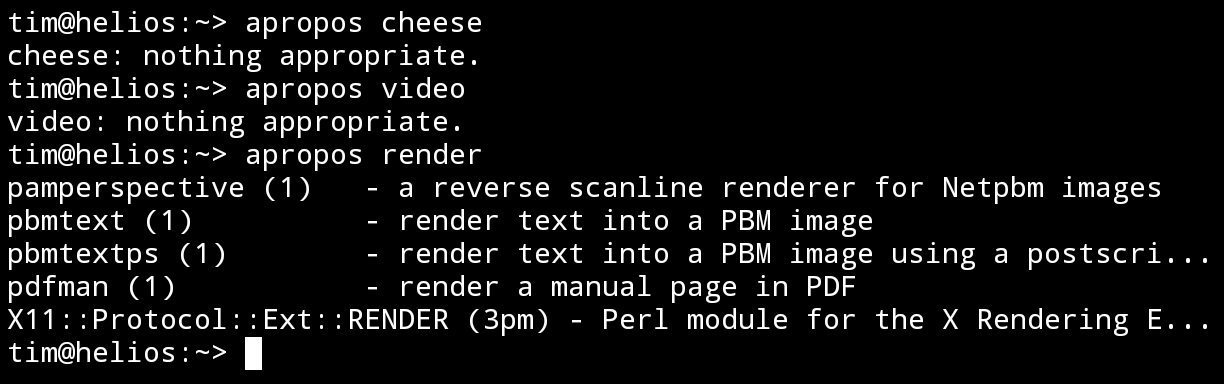
openSUSE server output, showing the results of the following commands:
apropos cheese
apropos video
apropos render
Only the last one has yielded any relevant man pages. The other two are not appropriate, apparently. ("Out of cheese" error, anyone?)
@nina_kali_nina When I bought the CDs for Slackware Linux, like thirty-something years ago, they came with a massive manual. A physical book I mean. I'm quite sure it mentioned also apropos.
Today what's like, launch a do-it-all web installer and wait to set -maybe- the root password?
Then google for instructions about anything? So to have some cut and paste actions, and finally get lost in some overly complex web development environment.
@nina_kali_nina yeah, but I just use `man -k`, it's stupid to learn and type a new name for the same command
Felt cute, might delete later

Alt...
Extreme close-up photo by Mary-Mariah of her cat laying on bed with her legs & high-heel, black boots in the air (making it look like it's the kitty's human legs). The tabby is smiling with its vampire teeth and does indeed look cute (like all cats!)
Akko has developed the film from the camera that I accidentally soaked in Coke Zero. The closer to the spill the more damage to the film, with the last 10 or so photos completely lost. Those that survived look like mood.

Alt...
A black and white photograph of a medium-sized building (a hotel)

Alt...
A black and white photo of a GWR train on a platform

Alt...
A black and white photo of a seafront, with waves coming. The photo is severely damaged, with bits of film flaking off
@nina_kali_nina still, interesting...
Personally, I looked into the "Coffee Processing Method" several years back…
![[?]](https://cdn.floofy.tech/accounts/avatars/109/365/586/230/096/090/original/09d7a098d607ba2d.png)

![[?]](https://assets.merveilles.town/accounts/avatars/110/618/037/889/897/311/original/7685c244dff08111.png)
![[?]](https://toot.mirbsd.org/fileserver/01GS55SW7VWYN3BFRYCX5NW526/attachment/original/01E0WMWASQCF8MPB3SR7F5R557.jpeg)
![[?]](https://manmachine.me/social/max/s/avatar-6ae1448a9abc4478bc7db96b78ff84a9.png)
![[?]](https://files.mastodon.social/accounts/avatars/000/011/307/original/dana-andi-portrait-square.jpg)
![[?]](https://s3.eu-central-2.wasabisys.com/mastodonworld/accounts/avatars/109/326/411/201/437/721/original/9e99fb9d7b4b3c4b.png)
![[?]](https://files.mastodon.social/accounts/avatars/115/289/695/482/543/462/original/d54142618002a701.jpeg)
![[?]](https://media.beige.party/accounts/avatars/115/896/987/149/631/928/original/5897651e46b1e1e9.png)
![[?]](https://cdn.masto.host/mastodongamedevplace/accounts/avatars/114/482/863/960/229/387/original/5dd3cda413077254.png)
![[?]](https://fux.am/fileserver/019XSVJ765T07Y8QE0TWSFVGG0/attachment/original/01JSHZFMJW24RMMBZB54BNGFNG.png)

![[?]](data:image/png;base64, iVBORw0KGgoAAAANSUhEUgAAAEAAAABAAQAAAACCEkxzAAAAUUlEQVQoz43R0QkAMQwCUDdw/y3dwEvsvzlL4X1IoQkAisKmwfAFT3RgJHbQezpSRoXEqeqCL9BJBf7h3QbOCCxV5EVWMEMwG7K1/WODtlvxAYTtEsDU9F34AAAAAElFTkSuQmCC)
![[?]](https://media.me.dm/accounts/avatars/109/979/926/852/850/148/original/42a17804e25fb7e9.png)
![[?]](https://cdn.masto.host/mastodongamedevplace/accounts/avatars/000/000/359/original/6a60c3203ff02293.png)

![[?]](https://files.mastodon.social/accounts/avatars/000/026/462/original/a84e6ece2e8aa6cd.png)
![[?]](https://masto.es/system/accounts/avatars/112/073/243/283/194/187/original/efc0516b5ac4f28c.jpg)

![[?]](https://joinfriendica.de/photo/profile/hackbyte.jpeg?ts=1754790903)
![[?]](https://cdn.masto.nyc/accounts/avatars/113/856/963/457/549/820/original/5c3a8903b759a7e8.png)
![[?]](https://assets.chaos.social/accounts/avatars/000/140/835/original/58c3307bd898df45.png)
![[?]](https://cdn.sociale.network/accounts/avatars/000/088/966/original/c084124dda4dfbba.png)
![[?]](https://cdn.masto.host/socialchiefgyk3dcom/accounts/avatars/109/268/597/379/110/484/original/2a1dbefce11b4c4d.png)
![[?]](https://social-coop-media.ams3.cdn.digitaloceanspaces.com/accounts/avatars/109/292/548/115/399/400/original/1dd288cdd5781292.png)
![[?]](https://cdn.masto.host/mastodongamedevplace/accounts/avatars/109/308/771/535/668/266/original/435bcee4b7d1fc51.png)
![[?]](https://files.mastodon.social/accounts/avatars/000/213/444/original/c9c2c7c05be94f1d.jpg)
![[?]](https://files.mastodon.social/accounts/avatars/000/425/168/original/350674df4373214e.png)
![[?]](https://files.mastodon.social/accounts/avatars/107/300/603/468/739/351/original/37c9f77352df6378.jpg)
![[?]](https://media.mstdn.social/accounts/avatars/109/269/922/679/986/135/original/b26c540e66afc9b7.jpg)
![[?]](https://media.plaza.minkalia.city/1779628341923_6fcb2d0eed016af3e5388da6d205e0fb5358b999_processed.webp)

![[?]](https://cdn.masto.host/mastodongamedevplace/accounts/avatars/000/012/792/original/7db9f7471b373748.png)
![[?]](https://files.mastodon.social/accounts/avatars/113/915/548/092/867/456/original/c3d0fbc73d5b7aa8.jpg)
![[?]](https://mastodon.sdf.org/system/accounts/avatars/109/592/070/869/223/273/original/912dfb7861745e85.png)
![[?]](https://media.social.cologne/accounts/avatars/116/232/768/628/584/081/original/ea46d97fba3b20ec.jpg)
![[?]](https://files.mastodon.social/accounts/avatars/001/283/849/original/ee7deb0631773519.jpeg)
![[?]](https://assets.toot.cafe/accounts/avatars/000/093/820/original/387521aaf2e69df6.jpeg)
![[?]](https://media.mementomori.social/accounts/avatars/113/787/933/609/073/931/original/1f4ff08dfba2637c.png)
![[?]](https://files.mastodon.social/accounts/avatars/000/691/094/original/6444289115b174f8.gif)
![[?]](https://mastodon.well.com/system/accounts/avatars/112/576/890/080/816/603/original/0f84c73e63efb281.jpeg)
![[?]](https://files.woof.group/accounts/avatars/110/712/980/611/067/920/original/89392bf192f1b097.jpeg)
![[?]](https://files.ohai.social/accounts/avatars/109/394/994/483/290/939/original/042f8f051ab9a65e.png)
![[?]](https://files.functional.cafe/accounts/avatars/000/005/820/original/c54185124437d7de.png)
![[?]](https://rls.social/system/accounts/avatars/109/280/945/988/216/359/original/ea3dc48fedd27036.jpg)
![[?]](https://cdn.fosstodon.org/accounts/avatars/109/302/571/045/121/750/original/9cbcc385f5bd638e.jpg)
![[?]](https://m.f-h.co/cosocial-ca/accounts/avatars/115/277/491/921/712/020/original/a6595e210df962b0.jpeg)
![[?]](https://files.mastodon.social/accounts/avatars/000/035/299/original/586c25127429d0f7.jpg)
![[?]](https://cdn.fosstodon.org/accounts/avatars/113/920/318/614/808/724/original/8699f6ae88b760c4.png)
![[?]](https://media.mstdn.social/accounts/avatars/109/349/941/912/741/020/original/8dc30e25f99a6669.jpg)
![[?]](https://files.mastodon.social/accounts/avatars/000/035/217/original/b4fad7872b07131b.png)
![[?]](https://cdn.masto.host/floss/accounts/avatars/109/330/977/778/074/013/original/d293e3e7b6247313.jpg)
![[?]](https://files.mastodon.social/accounts/avatars/000/598/376/original/8fab022a3689800d.png)
![[?]](https://file-is.no-pony.farm/accounts/avatars/110/057/136/931/675/789/original/6a6100db62aabbbf.gif)

![[?]](https://media.pfedi.pfriedma.org/media/53cdf61c81c8a0ffa000ec90967b7a37b1cf729f3f5a0d68d3d08e80671ed1c4.jpg)
![[?]](https://files.mastodon.social/accounts/avatars/000/023/457/original/ad501ceca43dd473.png)
![[?]](https://files.mastodon.social/accounts/avatars/001/154/272/original/46401ffeb9143e80.jpg)
![[?]](https://tootles.n7.gg/accounts/avatars/109/315/910/497/087/700/original/c8f93ad512a86af0.png)
![[?]](https://friend.camp/system/accounts/avatars/000/047/757/original/4dfe0ce6819abefc.png)
![[?]](https://cdn.masto.host/mastodongamedevplace/accounts/avatars/110/876/138/206/769/646/original/1c5bfb0a0a5e3c8b.png)
![[?]](https://media.mstdn.social/accounts/avatars/109/467/884/352/059/999/original/c498bf748103205c.png)
 [
[![[?]](https://cdn.masto.host/socialsecurityplumbing/accounts/avatars/108/247/564/189/285/875/original/964f8e6b70522b9b.png)
![[?]](https://cdn.masto.host/mastohackerstown/accounts/avatars/114/326/197/758/308/722/original/e10d8bdbfa042f1f.jpg)
![[?]](https://assets.chaos.social/accounts/avatars/108/195/841/919/578/029/original/b9457c2da03bee91.jpg)
![[?]](https://cdn.masto.host/mastodongamedevplace/accounts/avatars/109/363/699/576/676/664/original/e1ce02c553001393.jpeg)
![[?]](https://media.mas.to/accounts/avatars/114/556/273/153/837/791/original/efb37a96f74180ce.jpg)
![[?]](https://cdn.fosstodon.org/accounts/avatars/109/360/267/788/283/933/original/3d738f168b583fb2.png)
![[?]](https://cdn.masto.host/mastodongamedevplace/accounts/avatars/114/540/299/225/966/374/original/53a6471679b65990.png)
![[?]](https://cdn.masto.host/mastodongamedevplace/accounts/avatars/000/000/152/original/39ad959a773293d9.jpg)
![[?]](https://cdn.masto.host/topspicysocial/accounts/avatars/108/193/312/085/007/638/original/8c2c4345dce1b25a.jpeg)
![[?]](https://toot.wales/system/accounts/avatars/109/513/098/416/166/403/original/8ecf7686cc0c1e9d.png)
![[?]](https://files.mastodon.social/accounts/avatars/000/015/243/original/media.jpg)
![[?]](https://cdn.masto.host/mastodongamedevplace/accounts/avatars/108/578/495/354/726/270/original/b5007ad1b3a84ddc.png)
![[?]](https://byteheaven.net/system/accounts/avatars/109/542/931/349/332/592/original/2aaa0e6b1babf835.png)
![[?]](https://comam.es/snac/susie.png)
![[?]](https://hj.9fs.net/khm/s/7accaff1d29c5d074218919d4150d1e5.png)
![[?]](https://media.bsd.cafe/bsdmmedia01/accounts/avatars/110/740/169/477/916/693/original/dfa8f1b9beefa405.png)
![[?]](https://snac.chasmcity.net/gmc/s/avatar-39a28207b803e450badeee8cec677bc1.jpg)
![[?]](https://snac.smithies.me.uk/justine/s/avatar-270304302821a87b50026a5768a00c56.png)
![[?]](https://media.ravenation.club/accounts/avatars/109/525/575/926/250/374/original/dbda8ff71c6e94bf.png)
![[?]](https://digipres-club.s3.bhs.io.cloud.ovh.net/accounts/avatars/109/990/919/515/395/368/original/f8b07fef17cecfbd.png)
![[?]](https://mastodon.sdf.org/system/accounts/avatars/109/331/288/992/329/995/original/d5d663719e10bf6c.jpg)
![[?]](https://media.mas.to/accounts/avatars/116/428/043/228/145/703/original/4a847b1df7d0f643.png)
![[?]](https://files.mastodon.online/accounts/avatars/108/195/604/798/433/237/original/b072e57c1add0098.png)
![[?]](https://stockroom.wandering.shop/accounts/avatars/109/372/452/915/001/526/original/4ce2566f515ab4c3.png)
![[?]](https://s3.c.im/accounts/avatars/111/066/055/160/221/980/original/42c6fe958e54d2eb.png)
![[?]](https://files.bitbang.social/accounts/avatars/000/024/468/original/28486b6ddef1718e.webp)
![[?]](https://birdbutt.com/system/accounts/avatars/109/767/358/226/959/787/original/af9d2e814889589b.png)
![[?]](https://nondeterministic.computer/system/accounts/avatars/109/304/133/585/588/937/original/ae846752f45231f1.png)
![[?]](https://assets.chaos.social/accounts/avatars/108/199/388/891/200/520/original/6e642abcc251e6a9.jpg)
![[?]](https://files.mastodon.social/accounts/avatars/109/297/267/936/822/269/original/aca229035758186e.jpg)
![[?]](https://s3.metapixl.com/metapixl-media/cache/avatars/576074484176333270/avatar_ucyny7.png)

![[?]](https://cdn.masto.host/mastodongamedevplace/accounts/avatars/110/792/390/898/515/357/original/71ce30f84d907910.png)
![[?]](https://sbom.tilde.website/accounts/avatars/109/241/586/138/071/764/original/81b4d6ac10c42bf6.png)
![[?]](https://media.mastodon.scot/accounts/avatars/109/298/824/404/253/689/original/bcc18f75356ca37c.jpeg)
![[?]](https://cdn.masto.host/mastodongamedevplace/accounts/avatars/114/993/126/677/378/586/original/5fd6be28f2c65222.jpg)
![[?]](https://media.tech.lgbt/accounts/avatars/110/567/712/372/294/424/original/90fa5c71030609d5.png)
![[?]](https://media.sakurajima.moe/accounts/avatars/111/180/090/776/504/104/original/8ccc7739d5b0d716.png)
![[?]](https://ecoevo-social.s3.de.io.cloud.ovh.net/accounts/avatars/113/835/581/771/132/099/original/662e3144c28ac515.png)
![[?]](https://files.mastodon.social/accounts/avatars/109/245/152/864/356/162/original/fd7c9bd9e0e7a583.jpg)
![[?]](https://s3.qaf.pp.ua/media/accounts/avatars/116/906/449/450/988/726/original/c1618b2747ce4a66.jpg)

![[?]](https://mediacdn.aus.social/accounts/avatars/000/064/945/original/ZYT4GJWCXLVJ.png)
![[?]](https://cdn.masto.host/dicecamp/accounts/avatars/109/298/797/685/779/829/original/cd0d9eb83173a1b6.png)
 [
[![[?]](https://corteximplant.com/system/accounts/avatars/115/096/884/826/688/415/original/4dbc663f646fee0b.png)
![[?]](https://media.tech.lgbt/accounts/avatars/109/093/165/028/047/640/original/7463f84b80dc117a.jpg)
![[?]](https://typo.social/system/accounts/avatars/109/313/698/978/921/520/original/c46f1882e5d23705.png)
![[?]](https://media.mas.to/accounts/avatars/108/194/150/296/213/088/original/7291b49e47afb766.png)
![[?]](https://cafe.mycelium.locahlo.st/fileserver/01KFPYF9Y9VCZJNR2SBQSFA8B7/attachment/original/01KFN2QQ9QTKWK29GG08RTK9BQ.png)
![[?]](https://mastodon.tymoon.eu/system/accounts/avatars/000/000/001/original/f4be28598a3f3576.png)
 [
[![[?]](https://mastodon-media.jsteuernagel.de/mastodon-media/accounts/avatars/112/156/202/304/729/291/original/a816f9d6d4f16708.jpg)
![[?]](https://awesome.garden/system/accounts/avatars/109/593/993/412/791/963/original/212c784db254e278.png)
![[?]](https://dosgame.club/system/accounts/avatars/109/296/835/094/720/402/original/10281937241472e0.jpg)
![[?]](https://files.sfba.social/accounts/avatars/108/675/435/015/113/697/original/edd1b4e8d55fe670.jpeg)
![[?]](https://assets.chaos.social/accounts/avatars/108/197/118/634/352/812/original/b65789d54581785b.png)
![[?]](https://files.mastodon.social/accounts/avatars/000/034/829/original/bd62bd86b9f281f0.jpg)
![[?]](https://assets.chaos.social/accounts/avatars/000/004/084/original/37ec5132fabc2b7d.jpg)
![[?]](https://media.infosec.exchange/infosec.exchange/accounts/avatars/109/327/540/940/053/921/original/7e894651f5312787.png)
![[?]](https://media.tech.lgbt/accounts/avatars/116/655/881/384/112/498/original/0d17e01327d94ec5.png)